

This article pivots away from specific trading strategies to explore the heuristics I’ve uncovered in improving my trading performance. Surprisingly, the key wasn’t in refining strategies, but in implementing regular self-review intervals and adapting based on analyzing the root causes of my failures. This process reveals that to truly master trading—or any craft—you must apply this approach to all areas of your life. Physical and mental fitness, social connections, and contributing to society (which trading alone doesn’t fulfill) are all crucial components.
The Multifaceted Path to Mastery
To truly master trading or any complex skill, you need to look beyond the domain-specific techniques. The real breakthroughs come from:
- Regular self-review and analysis
- Adapting quickly based on identified failure points
- Applying the mastery process to all life areas
- Balancing physical fitness, mental health, social connections, and societal contributions
This holistic approach is essential because trading, like many challenging pursuits, doesn’t provide a sense of broader contribution until you’ve achieved significant success.
The Pitfalls of Single-Minded Pursuit
I want to caution against immediately diving full-time into a skill like trading. Maintaining work in other areas can be surprisingly beneficial. Here’s why:
- Diverse work experiences demonstrate adaptability and creativity.
- Relying on trading for your income without a very large padding will put undue stress on the process and is likely to cause worse decision making.
- You risk extreme isolation if your primary focus is trading, and that doesn’t end well. Many traders lose their fitness and get a little mentally off balance until they go through the process of coming undone and see the outcomes are not positive. I’ve had 2 periods where I was losing my mind in isolation and learning the truths about the financial system.
The Delayed Gratification of Artistic and Trading Pursuits
Creating art and trading provide little sense of immediate reward or contribution. When you begin these pursuits, your taste far exceeds your output capabilities. It’s an incredibly frustrating process, marked by glimpses of progress followed by apparent setbacks. While growth is occurring, it’s challenging to feel positive about your contributions to the world, which can be depressing.
Drawing from my experience in music production and DJing, it took nearly two decades before I felt confident in the quality of my output. Even then, only a select few connected with my work, as I was reluctant to compromise my artistic vision.
The Value of Balanced Pursuits
Because substantial rewards in complex, multifaceted skills like music production and trading may not materialize for years, fully immersing yourself in these skills from the outset can lead to soul-crushing depression and mental instability. I speak from personal experience here.
Mastering such skills requires a blend of psychological and technical proficiency that seems impossible to acquire without direct mentorship. Trading is particularly challenging because no book, course, or product can truly teach profitability. The industry is rife with charlatans peddling ineffective solutions.
In such a hostile environment, the friendly faces, structure, and stability that a day job provides become invaluable. This doesn’t mean abandoning your dreams and passions; rather, your job offers an opportunity to connect with the world and contribute meaningfully while providing the time and means to pursue your art with equal vigor.
As Kevin O’Leary wisely stated, “I don’t hire workaholics” – it’s crucial to engage your brain in diverse ways. If you’re a musician, constantly playing your guitar might indeed make you a workaholic!
The key is to find a balance that allows you to pursue your passion while maintaining other aspects of your life. This balance not only provides financial stability but also contributes to your overall well-being and can even enhance your performance in your chosen field.

The Psychological Shift: From Strategy to Self-Mastery
To achieve success, traders must shift their focus from strategy optimization to developing psychological insight, discipline, and self-control. This process must be constant and iterative, building intentionally on all previous gains from their “journeys.” Successful traders learn to work with shifting market conditions, minimizing losses and maximizing gains. As they find consistency, they complete the first major arc of their trading journey. However, this is not the end—a sequel awaits.
The Next Frontier: Holistic Self-Management
At this stage in my trading career, I’ve come to a crucial realization: my resources of energy and health are gradually depleting. This awareness has prompted me to refocus on creating high-quality, dedicated creative work time, prioritizing exercise, and building relationships (which aligns with my remote work situation). The challenge lies in making these new patterns “stick.”
I’m discovering that to truly advance, I need to shift my focus from skill mastery to self-management mastery. By extension, we can apply the tactics of skill mastery to all aspects of life: love, relationships, physical fitness, health, work, and art.
Balancing Challenge and Comfort
In developing any particular skill, it’s crucial to maintain a balance within the boundaries of tasks that are neither too difficult (which causes anxiety) nor too simple (which leads to boredom). This “sweet spot” of challenge is where growth and mastery occur most effectively.
The Holistic Approach to Personal Development
By applying the principles of skill mastery to self-management, we create a framework for comprehensive personal growth. This approach recognizes that success in one area of life often correlates with and supports success in others. For instance:
- Physical fitness enhances mental clarity and trading performance.
- Strong relationships provide emotional support during challenging market conditions.
- Effective time management skills improve both work productivity and trading discipline.
- Cultivating creativity in art can inspire innovative trading strategies.
Implementing Lasting Change
To make these new patterns endure:
- Start small: Introduce changes gradually to avoid overwhelming yourself.
- Create accountability: Share your goals with others or use tracking tools.
- Build routines: Integrate new habits into existing daily structures.
- Reflect regularly: Review progress and adjust as needed, just as you would with trading strategies.
- Celebrate small wins: Acknowledge progress to maintain motivation.
By viewing personal development through the lens of trading mastery, we can create a more balanced, fulfilling life that not only enhances our trading performance but also enriches our overall existence.
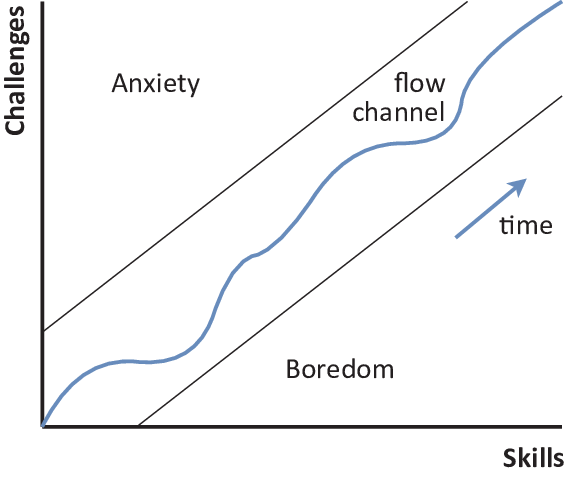
The Flow Channel: Balancing Skill and Challenge
As your skills improve, the challenge of tasks must increase to keep you in the “flow channel.” Consider a new employee’s onboarding process: they might start by fixing a simple bug. While the task itself isn’t complex, navigating the new environment provides the necessary challenge. As they acclimate, the complexity of tasks should increase to maintain engagement.
Beyond Skill Development: Addressing Systemic Challenges
Recent experiences have revealed that boredom or challenge can stem from factors beyond skill level. Machine learning model training exemplifies this: the lengthy process of training and validation creates significant lulls between iteration cycles. Google has observed that many machine learning projects never reach production, largely due to these extended cycle times. It becomes incredibly difficult to maintain focus and justify continued investment when rapid iteration is impossible.
Similar issues arise in software development, where slow test cycle times can severely impact human engagement. The need to wait and then switch context back to the task creates a significant barrier to exploring, understanding, and safely modifying software.
Overcoming Slow Cycles and Context Switching
The solution to these challenges isn’t always found in skill development alone. Slow cycle times and heavy context switching make it challenging to build the necessary skills and knowledge to address these issues effectively. One approach is to alternate between the main task and smaller, more manageable problems. This strategy allows you to:
- Recognize the underlying problem
- Develop a plan to address it
- Consult expert advice to avoid “making the same mistakes with greater intensity” (Eric Boles)
Personally, I’m taking courses in Machine Learning with Google Cloud to improve my Python skills and explore faster idea testing using tools like BigQuery ML. These courses often address the human factors involved in machine learning projects.
Applying Iterative Approaches to Daily Life
To truly progress, we need to broaden our focus beyond skill development and apply incremental, iterative approaches to our daily routines. Recent personal experiences, such as discontinuing ADHD medication, have highlighted the fragility of established habits and routines. The constant exposure to screens and dopamine-triggering stimuli can exacerbate these challenges.
Rebuilding Healthy Habits
As I work to rebuild my routines, I’m focusing on:
- Reestablishing a meditation practice
- Rebuilding an exercise routine
- Reinstating daily checklists
- Improving cardiovascular health
- Balancing screen time and real-world interactions
The Power of Habit Tracking
Habit tracking can serve as a foundational practice for personal development. Start small:
- Begin by simply tracking that you looked at your habit sheet and checked a box.
- Once that becomes a solid daily habit, add simple tasks like “tie your running shoes” or “touch your guitar.”
- Gradually increase complexity: “Plan 3 realistic goals for your work day.”
The key is to celebrate small wins and build momentum.
The Role of Journaling and Self-Reflection
Regular self-review and journaling are crucial components of this process. Personally, I process many of my experiences through writing, whether it’s on platforms like Slack, Discord, or in personal journals. This practice has been reinforced by resources like “The Artist’s Way” and the experiences of peers in creative fields.
Journaling serves multiple purposes:
- Processing and reflecting on experiences
- Tracking progress and identifying patterns
- Setting intentions and goals
- Exploring and developing ideas
Striving for Balance and Continuous Improvement
The ultimate goal is to achieve a balance across all aspects of life: work, relationships, personal passions, and health. By applying structured, iterative approaches to each area, we can avoid neglecting important aspects of our lives and prevent the tendency to “doom scroll” or fixate on negative information.
Each day presents an opportunity to improve upon the last, prioritizing what truly needs care and attention. By maintaining this balance and continuously sharpening our skills and habits, we prepare ourselves to meet life’s challenges and opportunities with readiness and enthusiasm.
Remember, if we can’t keep things in balance, we’ll struggle to excel in any single area. The key is to strive for holistic improvement, one small step at a time.


 k-xs
k-xs 
Leave a comment