
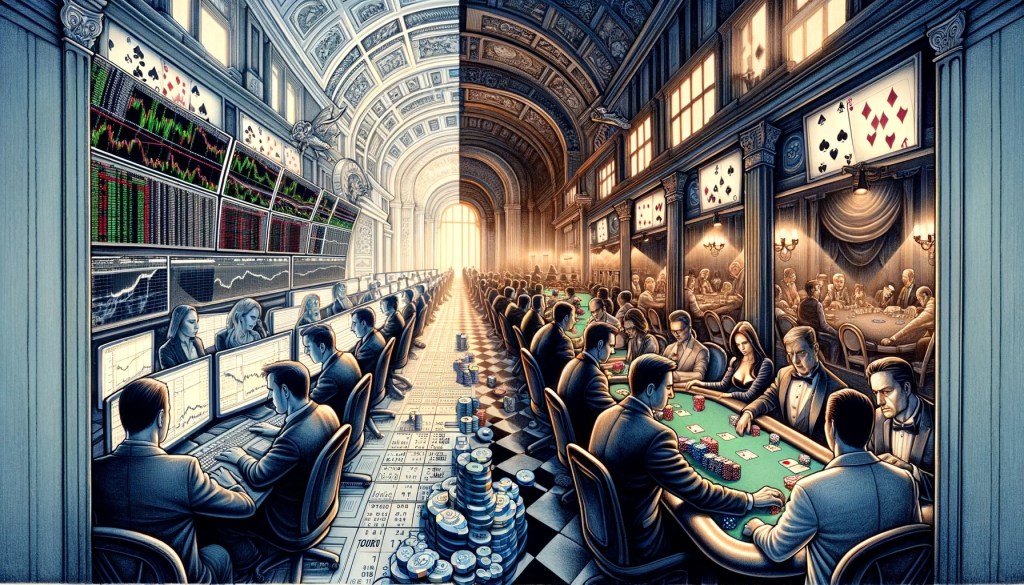
Day trading and poker are two seemingly disparate activities, one rooted in the financial markets and the other in gambling, yet they share striking similarities in strategy, psychology, and the management of risk. Both require a deep understanding of the odds, an ability to make quick decisions with incomplete information, and a disciplined approach to risk management and position sizing. I was surprised to find my Dad giving me back sayings like “The guy at the race track only calls home on the days that he wins.” It was a major hurdle for me to overcome this psychological hurdle, but as I learned the skills of trading, and I tried playing Poker, I could see that the games are very similar. This article explores these parallels, with a particular focus on how traders and poker players navigate the uncertainties inherent in their respective fields.
Understanding the Odds
At the core of both day trading and poker is the fundamental concept of odds. Day traders analyze market conditions, historical data, and current events to gauge the probabilities of their trades being successful. Similarly, poker players calculate pot odds, the likelihood of winning a hand against the number of chips required to stay in the game. Both require the ability to assess risks and rewards quickly and accurately, often under pressure.
Decision Making with Incomplete Information
Both day traders and poker players must make high-stakes decisions based on incomplete information. In day trading, the full scope of market influences can never be entirely known; traders must act on the information available, such as price movements and trading volume, to make their best guess about future market behaviour. Similarly, poker players must infer the strength of their opponents’ hands through their betting patterns and physical tells while not knowing exactly which cards will come next.
Risk Management
Risk management is crucial in both arenas. Successful day traders and poker players understand that preserving their capital is key to long-term success. They employ strategies to minimize losses, such as setting stop-loss orders in trading or folding in poker when the risk outweighs the potential reward. This discipline ensures that they stay in the game long enough to capitalize on winning opportunities.
Position Sizing
Closely related to risk management is the concept of position sizing. In day trading, this means determining how much of their portfolio to risk on a single trade based on the perceived risk and potential return. In poker, it’s about deciding how many chips to bet to maximize winnings while minimizing losses. Both require a careful balance, ensuring that a single loss doesn’t significantly impact the overall capital or chip stack.
Competition Matters
One crucial aspect where day trading and poker diverge is in the nature of their competition. In poker, the skill level of your opponents greatly influences your chances of success. Playing against less skilled players can significantly increase your odds of winning. In contrast, the financial markets are an impersonal opponent where the competition includes everyone from individual retail traders to institutional investors. While market participants can benefit from others’ errors or misjudgments, the market itself offers no easier “table” to choose. While there is some variance in the level of competition between markets, generally most markets have most of the alpha “mined out” by the time you read the price. Machine learning was much easier in markets than it was today, and the level of competition increased significantly once machine learning entered the scene around 2012. Similarly, online poker is likely dominated by bots that that compete out players at tables today. During certain periods of time (market open and close), or during “catalysts” like news events, or when large players can’t “hide” their positions, there are more inefficiencies that represent alpha that can be caught. Most of what I do is in finding macro/news events, or in identifying large players that are sitting at a table with a grin they can’t conceal. The players at the table lose their ability to capture all of the money at the table.
Psychological Aspects
Both fields demand strong psychological resilience. The stress of making rapid decisions with significant financial implications can lead to emotional trading or playing, deviating from rational, strategy-based decisions. Successful practitioners in both domains learn to manage their emotions, focusing on long-term strategy rather than short-term wins or losses.
Conclusion
Day trading and poker share remarkable similarities in their reliance on understanding odds, making decisions with incomplete information, and employing disciplined risk management and position sizing strategies. However, the element of competition in poker can make it a “worse” game if you’re facing highly skilled opponents, highlighting the importance of choosing your battles wisely. Both require not just technical skill and knowledge but also psychological strength and emotional control. Whether navigating the volatility of the financial markets or the uncertainty of the poker table, the principles of risk management and strategic play are universally applicable, underscoring the profound connection between these two seemingly different


 k-xs
k-xs 
Leave a comment